IB Physics emf

The term emf is a misunderstood concept. Listed below are a number of possible definitions. Which are correct? What must be added/deleted to make them correct?

  1. The voltage of a battery.
  2. The potential difference of a battery.
  3. The potential difference of the battery when no current is flowing through it.
  4. The work done per unit positive charge.
  5. The power per unit current.
  6. The work done in moving a charge between two points.
  7. The work done in moving a +1 C charge at a constant speed along a path in an electric field.
  8. The integral of the electric field along the path taken.
  9. The line integral of the electric field component parallel to the path taken along the path taken.
  10. The work done in moving a +1 C charge at a constant speed around a closed path in an electric field.
  11. The emf of a cell is the work done per unit positive charge in going around the circuit.
IB Physics Galileo's Pendulum

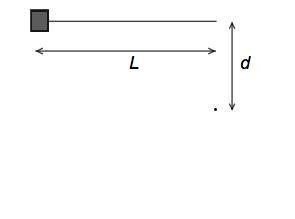
A tutorial sheet on Galileo’s pendulum, a pendulum where the string strikes a peg as the pendulum swings, is given below. The length of the string is L and the peg is a distance d below the point of support of the string.

  1. In the diagram the mass is released from rest on the end of a light inextensible string with the string initially horizontal. Determine the speed of the mass at the lowest point in its swing.
  2. In question 1, d = 0.5L. Find the maximum height reached by the mass above the peg after the string strikes the peg.
  3. In question 1 show that d must be at least 0.6L if the mass is to swing completely around the peg.
  4. The mass is placed on a string of length 1.0 m and released with the string making an angle of 60° with the vertical. If d = 0.7 m, find the angle made by the string with the horizontal when the mass reaches its highest point. (41.8°)
  5. If d = 2L/3, find the least angle to the vertical at which the string can be released if the mass is to swing completely around the peg. (80.41°)
  6. The string is replaced by an elastic spring of force constant k. The mass m is released from rest with the spring horizontal and unextended. Is the speed of the mass at the bottom of the swing greater than, equal to or less than, the speed of the mass when the string is inelastic?

Force on a Current

A tutorial sheet of questions on the force on a current is given below

  1. Define current.
  2. Define the SI unit for current.
  3. What are the charge carriers in a copper wire?

  4. When a current carrying wire is in an external magnetic field do the moving charge carriers in the wire experience a force?

  5. How is the force on the moving charge carriers transferred to the wire? (charge carriers experience a force moving them to one side of the wire creating a charge separation that exerts a force on the postive ions in the lattice of the wire pulling the wire sideways)
  6. Is the direction of the magnetic force on the wire the same as the magnetic force on the charge carriers?
  7. A uniform magnetic field is directed into the page. A current in a wire flows to the right. What is the direction of the force on the charge carriers in the current?
  8. A uniform electric field acts into the page. A current in a wire flows to the right. What is the direction of the force on the charge carriers?
  9. A positively charged particle moves to the right. The charge enters a uniform electric field directed into the page. Describe the force on the charge.
  10. In a Physics experiment a constant current flows in a long straight wire. Does the magnetic field produced by the current exert a force on the wire? Give a reason.

Doppler Effect for Sound

A tutorial sheet on the Doppler effect for sound waves is given below.

  1. State a definition of the Doppler effect for sound waves.
  2. A train moves to the east at a speed v. The speed of sound in air is vs. The train emits sound waves. Find the speed of the sound waves (a) in front of the train, (b) behind the train
  3. A fire truck has a siren of frequency f. The truck moves at a constant velocity v relative to the ground. The speed of sound in air is vs. What is the frequency of the sound waves heard by a stationary observer as the truck approaches them?
  4. In question 2 does the frequency of the sound heard by the observer increase, stay the same or decrease as the fire truck approaches?
  5. A train has a whistle of frequency f that emits sound waves that travel through air at a speed vs. The train moves at a speed u to the east. A second train moves to the east at a speed v, where u is less than v. Is the frequency of the sound waves heard on the second train f(v - u)/vs?
  6. A train has a whistle of frequency f that emits sound waves which travel through air at a speed vs. The train moves at a speed u towards a tunnel in a vertical mountain. Is the frequency of the reflected sound waves heard on the train 2fu/vs?

  7. A physics student drops a vibrating 440 Hz tuning fork down an elevator shaft in a tall building. When the student hears a frequency of 400 Hz, how far has the tuning fork fallen? Take the speed of sound in air as 340 m s-1. (Tippler, Physics, second edition, p 483)

IB HL Physics Poorly Answered Questions 3

A third tutorial sheet of questions on poorly answered HL concepts is given below.

  1. A 6 Ω resistor is connected in series with a cell of emf 12 V of zero internal resistance, an ideal ammeter and an ideal voltmeter. Find the reading on each meter.
  2. State the definition of emf.
  3. An electron is in the fourth excited state of the hydrogen atom. How many different spectral lines could appear in the emission spectrum of this atom?
  4. The strong nuclear interaction between two protons (a) can be equal to zero (b) is repulsive for distances less than 3 fm, (c) is attractive for distances less than 3 fm, (d) is always greater than the Coulomb interaction between the protons
  5. A particular radioactive substance undergoes β- decay. Does the daughter nuclide always have the same energy?
  6. Two positive point charges are at a fixed distance apart. When the electric field due to the charges is zero the electric potential is (A) zero, (B) a maximum value, (C) a minimum value, (D) not defined
  7. In quantum tunnelling (A) the particle tunnels under the obstacle and fully appears on the other side (B) the particle is described by a wave function that exponentially decays through the barrier and is detected with less energy on the other side (C) the particle is described by a wave function that exponentially decays through the barrier and is detected with the same energy on the other side (D) the particle passes through the barrier instantaneously (see Nature July 22, 2020)

IB SL Physics Poorly Answered Questions 4

A fourth tutorial sheet of questions that are not well answered in SL Physics is given below.

  1. A resistor X has the shape of a cylinder of cross sectional area A and length L. The resistance of X is R. What is the resistance of a resistor Y made of the same material as X having the same volume as X but one-half the length of X? The resistors are at the same temperature.
  2. An ideal gas particle of mass m moving at a speed v strikes the wall of the container at an angle of 𝜽 to the surface. What is the magnitude of the change in momentum of the particle due to the collision?
  3. A cell of emf E and internal resistance r is connected to a variable resistance R. The potential difference across the cell is V and the current in the circuit is I. The gradient of the graph of V versus I is (a) R, (b) r, (c) -r, (d) -R
  4. The emf of a cell is the work done in moving a unit positive charge through the cell. True or false?
  5. A trolley of mass M is pulled along a smooth horizontal surface with an acceleration a by a string tied to a falling mass. The string passes over a smooth pulley at the end of the table. Express the mass of the falling object in terms of a, g and M.
  6. The following nuclear reaction occurs, P + Q -> R + S. This reaction can be called nuclear fission if (a) energy is released, (b) P is a neutron, (c) R and S have a lower binding energy per nucleon than P + Q , (d) R and S have a higher binding energy per nucleon than P + Q
  7. A block of mass M moves at a speed U to the east. After a time interval t the speed of the block is V to the west. The magnitude of the impulse given to the block during this time interval is (a) M(V - U)t (b) M(V - U) (c) M(V + U)t (d) M(V + U)
  8. Which of the following equations is now used to define the kilogram? (a) F = mg, (b) F = ma, (c) hf = mc2 (d) E = mc2.

HSC Physics Moving Reference Frames

A tutorial sheet of questions on a moving object seen in a moving reference frame is given below.

  1. A bus moves to the west at a constant velocity. A ball is released from rest relative to the bus. Describe the path of the ball (a) relative to the bus (b) relative to the ground.
  2. A bus is moving to the east with a constant acceleration to the east. A ball is released from rest relative to the bus. Describe the path of the ball (a) relative to the bus (b) relative to the ground.
  3. A bus is moving to the east with a constant acceleration to the west. A ball is released from rest relative to the bus. Describe the path of the ball (a) relative to the bus (b) relative to the ground.
  4. An elevator is moving upwards at a constant velocity. A ball is thrown horizontally inside the elevator. Describe the path of the ball (a) relative to the elevator (b) relative to the ground.
  5. An elevator is moving upwards with a constant acceleration upwards. A ball is thrown horizontally inside the elevator. Describe the path of the ball (a) relative to the elevator (b) relative to the ground.
  6. A boy and a girl sit at opposite ends of the diameter on a rotating table. At a certain instant the boy is moving to the west and the girl to the east. The girl throws a ball that is caught by the boy. Describe the initial velocity components of the ball (a) relative to the table, (b) relative to the ground.
  7. A simple pendulum has a period of oscillation T. The pendulum is supported over the centre of a rotating reference frame of period of revolution P. Find the period of oscillation of the pendulum in the rotating reference frame when (a) P = T, (b) P > T, (c) P < T

HSC Physics Blackbody Radiation

A tutorial sheet of questions on the blackbody radiation follows.

  1. An iron bar is heated in a flame. Describe the energy released by the bar at a certain temperature.
  2. Does a heated iron bar produce a continuous, line emission spectrum, absorption spectrum or a combination of these?
  3. When a hydrogen discharge tube releases light a series of characteristic wavelengths can be observed. Does the gas produce a continuous spectrum as well?
  4. What is a black body? Is a blackbody a perfect absorber, a perfect emitter of radiation or both?
  5. What actually is the black body? Is it the high temperature walls of a container, the gas inside the container or a small hole in the wall of the container?
  6. A blackbody has its kelvin temperature doubled. Is more energy released at each wavelength?

IB Physics Circular Aperture Diffraction

Tutorial questions on HL Topic 9.4 are given below.

  1. In the equation 𝜽=1.22⋋/b, what does 𝜽 represent? ( The Rayleigh resolution criterion states that two point sources of equal intensity can just be resolved with a diffraction-limited optical device with a circular aperture if they are separated in angle by 1.22⋋/b radians, where b is the diameter of the aperture collecting light and ⋋ is the wavelength of the light. The central image of a point source is of angular radius 𝜽 and is called the Airy disc containing 84% of the energy in the image.)
  2. The images of two stars seen through a telescope are just resolved when yellow light is used. Will the images of these stars be seen as distinct when red light is used? (No. Red light increases the diameter of the Airy disc in an image so the Airy discs of each star will overlap more and the images are not resolved. The angle subtended by the stars at the telescope is the same. To obtain greater image resolution the wavelength must be reduced to produce narrower non-overlapping Airy discs in each image.)
  3. Two stars in a binary star system subtend an angle of 2.0 x 10⁻⁴ ° at the Earth. The stars are observed through a telescope in yellow light of wavelength 580 nm. Find the minimum diameter of the telescope that allows the star images to be resolved. (20.0 cm)
  4. Two star images are just resolved when the wavelength of light is ⋋ and the diameter of the telescope is b. Find the diameter of the telescope that can just resolve the star images in light of wavelength 1.5⋋. (1.5b)
  5. Two star images are just resolved when the wavelength of light is ⋋ and the diameter of the telescope is b. Find the wavelength of the light that can just resolve the images of these stars if a telescope of diameter b/4 is used. (⋋/4)
  6. Remember. Angular separation of stars = 𝜽, for resolution 𝜽 ≧ 1.22 ⋋/b

IB Physics Air Resistance is Small (but not negligible)

Most textbook problems state that air resistance, the drag force on a projectile due to friction as it moves through a fluid medium, is to be neglected. A tutorial sheet of “show that” questions for the case where the drag force is small compared to the weight are given below. All questions give approximate solutions, correct to the first order in k/m, where k is a small positive number called the drag constant and m is the mass of the particle.

  1. A particle of mass m falls vertically from rest through air. If the drag force is given by fd = -k v, where v is the speed of the object, show that the distance fallen at time t is given by s = 1/2 gt2( 1 - kt/(3m) ).
  2. A particle of mass m falls vertically from rest through air. If the drag force is given by fd = -k v2, where v is the speed of the object, show that the distance fallen at time t is given by s = 1/2 gt2( 1 - gkt2/(6m) ).
  3. A particle of mass m is projected at a speed u at an angle 𝛼 to the horizontal in air where the drag force is proportional to the velocity vector of the particle, fd = -k v⃗, where k is a small positive constant. Show that the time taken to reach the highest point is given by t = u sin𝛼/g - k u2sin2𝛼/(2mg2).
  4. A particle of mass m is projected at a speed u at an angle 𝛼 to the horizontal in air where the drag force is proportional to the velocity vector of the particle, fd = -k v⃗, where k is a small positive constant. Show that the path of the projectile is y = x tan𝛼 - g x2sec2𝛼/(2u2) + k/m( x2sin𝛼/(2ucos2𝛼) - 2/3x3/(ucos𝛼)3 )

IB Physics Projectile Thrown from a Cliff

The maximum range of a projectile on the horizontal level of its projection (neglecting air resistance) occurs when the angle of projection to the horizontal is 45°. A more difficult problem is when the point of projection is above the horizontal plane on which the object lands. A tutorial sheet of difficult “show that” problems is given below.

  1. A projectile is thrown at an angle 𝜽 to the horizontal at a speed u from a vertical height h. Show that the horizontal range of the projectile is u2/(2g)( sin2𝜽 +√(sin22𝜽 +8ghcos2𝜽/u2) ).
  2. A projectile is thrown at a speed u from a height h above horizontal ground. Show that the angle of projection to the horizontal for maximum range on the ground is tan-1√ (u2/(u2+2gh) ).
  3. A projectile is thrown at a speed u from a height h above horizontal ground. Show that the maximum range of the projectile is u/g√(u2+2gh).
  4. A projectile is thrown from a vertical height above the ground and maximum range occurs when the angle of projection to the horizontal is 𝜽. Show that the angle (in the maximum range case only) at which the projectile strkes the horizontal is 90° - 𝜽.

Mathematical Tripos Dynamics and Relativity 2021

Below are my answers to the 2021 MT Part 1A Dynamics and Relativity questions.

  1. 3C, t = m0( 1 - e-V0/U)/α
  2. 4C, Izz = M( a2 + b2 )/3
  3. 9C, Ve2 = 2λF0/m, escapes if Ve ≥V0, T = 8λ/( Ve√(1 - V02/Ve2) ) sin-1(V0/Ve)
  4. 10C, (c) (i) C=2 (ii) √( k/r1) √ ( Cr2/(r1 r2) - 1 ), √( k/r2) √ ( Cr1/(r1 r2) - 1 ) (iii) Use dA/dt = h/2, t = πab/h, t2 = π2a b2/(k(1-e2)) = π2a3/k = π2 (r1 + r2)3/(8k)
  5. 11C (ii) 𝜽 = 0, 𝜽 = cos-1(g/⍵2R), 𝜽 = 𝜋 provided g < ⍵2R. In this case 𝜽 = 0 and 𝜽 = 𝜋 are unstable and the period of small oscillations about 𝜽 = cos-1(g/⍵2R) is 2𝜋/⍵ ✕ 1/√(1 - g2/(⍵4R2)). If g > ⍵2R there is equilibrium when 𝜽 = 0 and 𝜽 = 𝜋. In this case 𝜽 = 0 is stable with a period of small oscillations 2𝜋/⍵ ✕ 1/√( g/(⍵2R) -1) )and 𝜽 = 𝜋 is unstable. If g = ⍵2R there is equilibrium when 𝜽 = 0 and 𝜽 = 𝜋. In this case the period of oscillations about 𝜽 = 0 is expressible in terms of a complete elliptic integral of the first kind and 𝜽 = 𝜋 is unstable. (iii)Force has perpendicular components N (towards the center of the circle) and Q (into the page). N = m(gcos𝜽 + ⍵2Rsin2𝜽 + R𝜽̇2), Q = 2mR⍵𝜽̇. F=√(N2 + Q2).
  6. 12C a = 1/(ɣm)( F - F·v v/c2 ), v = cqEt/√( c2m2 + q2E2t2 ). As t → ∞ , v → c.

IB Physics Two Masses and a String

A tutorial sheet with problems involving two masses connected by a string is given below.

A 2.0 kg block and a 3.0 kg block are tied to the ends of a light inextensible string. Find the tension in the string in each case.

  1. The blocks are released from rest with the 3.0 kg hanging below the 2.0 kg.
  2. The blocks are released from rest with the 2.0 kg hanging below the 3.0 kg.
  3. The blocks are pulled along a smooth horizontal surface by a force of 1.0 N applied parallel to the surface acting on the 2.0 kg block.
  4. The blocks are at rest on a rough horizontal surface of coefficient of static friction 0.4. A force of 1.0 N parallel to the surface is applied to the 2.0 kg block.
  5. The blocks are at rest on a rough horizontal surface of coefficient of static friction 0.4. A force of 3.0 N parallel to the surface is applied to the 2.0 kg block.
  6. A smooth pulley is at rest in the laboratory. The string is passed over the pulley and the blocks are released from rest.
  7. In question 6 the axle of the pulley accelerates upwards uniformly at 2.0 m s-2.
  8. In question 7 what must be the acceleration of the pulley if the blocks stay at rest relative to each other?

IB Physics Omega in Simple Harmonic Motion

Many good Physics students are confused when ⍵ is used in simple harmonic motion (SHM) questions. How can something moving in a straight line have an angular velocity ⍵? In SHM it is best to call ⍵ the angular frequency of the motion. SHM is the projection of uniform circular motion (UCM) onto a diameter of the circle.

  1. In Physics what is the name of the quantity that has the symbol ⍵?
  2. What is the SI unit for ⍵?
  3. Imagine that an object is moving in uniform circular motion (UCM) of radius 1.0 m and period 2.0 s. You are watching the object from the side and the object appears to be moving in simple harmonic motion. (a) what is the amplitude of the SHM? (b) what is the period of the SHM? (c) what is the angular velocity of the UCM? (d) what is the angular frequency of the SHM? (1.0 m, 2.0 s, 𝜋 rad s-1, 𝜋 rad s-1).
  4. The radius r of the circular path of a particle moving in UCM is the amplitude x0 of the image of the particle moving in SHM in a straight line along a diameter of the circle.
  5. The angle turned through in a time t by a particle moving in UCM is 𝜽 = ⍵t.
  6. The displacement of a particle from the equilibrium position in SHM is the component of the radius vector in UCM along the direction of the SHM. If at t=0, x=x0 then x = x0 cos(⍵t). If at t=0, x=0 and the particle is moving in the positive direction then x = x0 sin(⍵t). If at t=0, x=0 and the object is going in the negative direction then x = -x0 sin(⍵t).
  7. The speed of a particle moving in UCM is given by v = ⍵r. In SHM the velocity is the component of the UCM velocity vector along the direction of the SHM. If at t=0, x=x0 then v = -⍵x0 sin(⍵t). If at t=0, x=0 and the object is moving in the positive direction then v = ⍵x0 cos(⍵t). If at t=0, x=0 and the object is moving in the negative direction then v = - ⍵x0 cos(⍵t).

IB SL Physics Poorly Answered Questions 3

The third sheet of SL Physics questions on areas that are not well answered is given below.

  1. In a longitudinal wave what are the ray directions and direction of the wavefront? What are these directions for a transverse wave?
  2. A string of length 40 cm is fixed at each end and set oscillating in its fundamental mode. What is the phase difference between two points on the string that are 25 cm part?
  3. A particle is moving in simple harmonic motion. Sketch a graph showing the momentum of the particle versus its speed.
  4. When two waves interfere constructively what is the ratio of the intensity produced by the two waves interfering constructively to the intensity due to one of the waves only?
  5. An ammeter and a voltmeter are connected in series with a cell of emf 12 V connected to a 2 Ω resistor. What is the reading on each meter?
  6. An electron is accelerated from rest between two electrodes a distance d apart and the final kinetic energy of the electron is X eV. If the electodes are now placed a distance 2d apart the final kinetic energy of the electron is (a) X/√2, (b) X/2 (c) X (d) 2X
  7. A mass is placed on the end of a light rod of length L and is made to revolve in a vertical plane at a constant speed. At what point in the path is the force exerted by the rod on the mass maximum?
  8. Two resistors P and Q are made of the same material and are at the same temperature. P has twice the length of Q and one half the diameter of Q. If the resistance of Q is 2 Ω, find the resistance of P and Q when they are connected in parallel.

IB SL Physics Poorly Answered Questions 2

A sheet with SL questions that are not well answered is given below.

  1. The average speed of a hydrogen atom at -23 °C is v. Determine the average speed of a helium atom at -148 °C. (v/√8)
  2. The increase in volume ∆V of a solid when it is heated is proportional to both its volume V and change in temperature ∆T. What is the SI unit for the constant of proportionality?
  3. The energy stored in a stretched spring is E. What is the work done in doubling the extension of the spring? (3E)
  4. A simple pendulum of mass m is oscillating through an angle of 40°. What is the magnitude of the resultant force acting on the mass at the top of its swing? (mgcos20)
  5. A car starts from rest and moves in a straight line with uniform acceleration a. Draw a graph showing the distance travelled every second versus the total time taken.(straight line, gradient a, y-intercept -a/2)
  6. On another planet a ball is released from rest and falls 2.0 m in the third second of its movement. What is the gravitational field strength of this planet? (0.8 N kg-1)
  7. A stationary firework of mass M explodes into pieces of mass 3M/4 and M/4. The kinetic energy of the smaller piece is E. What is the kinetic energy of the larger piece? (E/3)
  8. A car moves at a constant speed v around a circular track. What is the magnitude of the change in velocity of the car after travelling through an angle of 60°? (v)

IB Physics Motion in a Vertical Circle

A sheet of vertical circle problems is given below.

  1. A mass m is tied to a string of length L and hangs vertically at rest. The mass is given an initial horizontal speed u. What is the initial acceleration of the mass?
  2. A mass on a string is released from rest swings as a simple pendulum. What is the speed of the mass when its vertical drop is ∆h?
  3. A mass m is placed on the end of a light rigid rod of length r and made to move in a vertical circle at a constant speed v. Is the magnitude of the acceleration of the mass a constant value of v2/r? (no, this is the radial component of the acceleration only)
  4. In the previous question draw a free-body diagram if the radius to the mass makes an angle 𝜽 with the vertical when 𝜽 < 90°. Show that the force exerted on the mass by the rod has a component mgsin𝜽 perpendicular to the rod and a component mv2/r - mgcos𝜽 parallel to the rod.
  5. In the previous question at what angle to the vertical is the force exerted by the rod maximum? (180°)

IB Physics Spring Problems

A sheet testing Physics concepts involving a mass on a spring is given below.

  1. At a certain instant a mass on a spring has zero velocity. Must it have zero acceleration?
  2. An object on a spring has zero acceleration at a certain instant. Must it have zero velocity?
  3. A mass on a spring is at rest. Is there no force acting on the mass?
  4. Is the tension in a spring equal to the resultant force acting on the mass?
  5. State Hooke's law (be careful).
  6. A mass moves in SHM on a spring. Is the speed of the mass at the instant it passes through the equilibrium position the same as the average speed during one oscillation?
  7. A mass M is placed on a spring of constant k that hangs vertically. If the mass is released from rest does the mass fall a distance Mg/k before coming to rest?
  8. A block of mass M rests on a smooth horizontal surface. A spring of force constant k connects the block to a wall on the left. On the right a constant horizontal force F pulls on the block. Is the extension of the spring F/k when the block comes to rest?
  9. A mass M is on a smooth horzontal table. Two identical springs, one on the left and one on the right, are connected to the mass. The other end of each spring is held at rest. If the mass is displaced a small amount in the line of the springs and released, what is the period of the oscillations? Each spring has a spring constant k.
  10. A spring has a spring constant k. The spring is cut in half. What is the spring constant of each section?
  11. A 2.0 kg mass slides from rest down an inclined plane of angle of elevation 30°. After travelling 4.0 m the mass encounters a spring of spring constant 100 Nm-1. Find the maximum compression of the spring if (a) the incline is smooth, (b) the coefficient of friction between the mass and the plane is 0.20. ((a) 0.989 m, not 0.885 m (b)0.783 m)
  12. In question 11 (b) determine the compression of the spring when the mass eventually comes to rest. (8.6 cm, from Tipler Physics 2nd edition page 220)

IB Physics Pulling Apart a Hydrogen Atom

  1. When a hydrogen atom is ionised does the mass decrease, stay the same or increase?

  2. When an electron “jumps down” to its ground state does the mass of the hydrogen atom decrease, stay the same or increase?

  3. When an electron “jumps up” from its ground state to its first excited state does the mass of the hydrogen atom decrease, stay the same or increase?

  4. Is the mass of a hydrogen atom equal to the mass of a proton plus the mass of an electron?

  5. Imagine that a proton and an electron link to form a hydrogen atom. Is energy released or absorbed in the process? In what form is the energy change?

  6. Is the proton in the hydrogen atom the same as a free proton?

  7. In the Bohr theory of the hydrogen atom the speed of the electron in the ground state is v. What is the speed of the electron in the first excited state?

  8. In the Bohr theory of the hydrogen atom the energy of the ground state is E. What is the energy of the first excited state?

  9. How can the hydrogen atom have a negative energy?

  10. The ground state energy of the hydrogen atom is -13.6 eV. A potential difference is applied to some hydrogen gas in a discharge tube. Will an applied voltage of 3.4 V cause the gas to emit light?

See Resnick and Halliday, Basic Concepts in Relativity and Early Quantum Theory , second edition, page 113

IB HL Physics Capacitors

  1. Where does the charge “go” when a capacitor discharges?

  2. Where does the energy “go” when a capacitor discharges?

  3. Is there an electric field between its plates when a capacitor discharges?

  4. Is there a magnetic field between its plates when a capacitor discharges?

  5. Is I = dq/dt correct when a capacitor discharges?

  6. Two charged capacitors are placed in series. Does the equation on page 11 of the Physics Data Booklet apply in this case?